Preventing foreign objects in the production environment of food processing companies requires a careful approach. The use of detectable materials plays a significant role in this. In this article, we discuss practical measures to prevent foreign particles in the production process and optimally protect your production environment with detectable materials.
What is (metal) detectability?
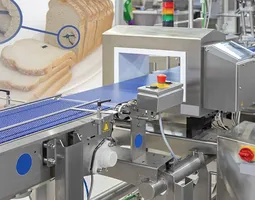
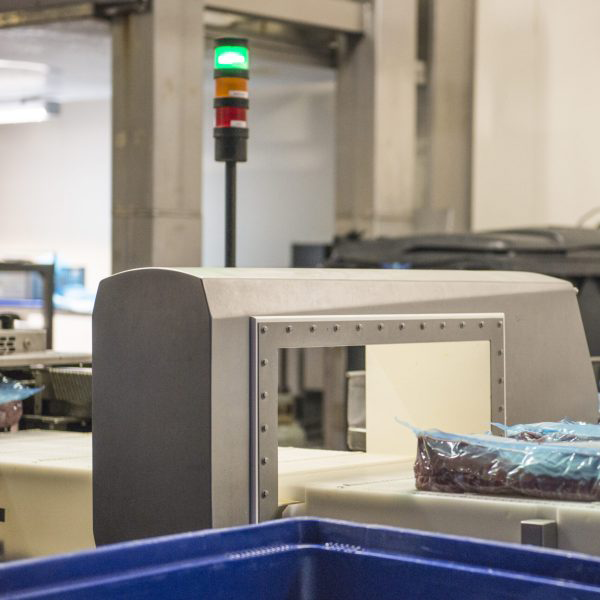
Detectability in the food processing industry is essential to identify foreign objects in the production process. So, imagine: an employee accidentally loses a piece of their blue glove in a batch of minced meat. If that piece is metal or X-ray detectable, then the metal or X-ray detector can detect it, and the product is rejected before it reaches the supermarket. Is a product detectable? This can also mean the product is visually detectable, for example, by a distinctive color.
What types of detectable materials exist?
There are many types of detectable materials. For example, consider:
- Earplugs made of foam or with flanges from Proteqtio or Honeywell
- Protective equipment like gloves, hairnets, and beard nets from Hycare
- Cleaning materials, such as hand brushes from Vikan or FBK
- (Cutting) tools from Martor
- Kitchenware such as scrapers, spatulas, and brushes from Vikan
- Safety stickers, labels, and plasters from Detectamet or Brady
- Pens, markers, and other writing and office supplies from Detectamet
What types of detectability are there?
Detetectable materials can be divided into four categories: fully metal detectable, partially metal detectable, X-ray visible, and dual detectable. Below, you can read about the differences between the various types of detectability. This way, you can better determine what properties the materials in your production environment should have.
Fully detectable
Fully metal-detectable materials, such as hairnets and gloves, contain tiny metal particles woven throughout the entire product. Because the material is fully detectable, even the tiniest particles can be detected by the metal detector in your process.
X-ray visible
X-ray systems detect foreign objects based on differences in density between the product and the material. Like most foods, plastics have a low density. For this reason, high-density additives are added to materials. This ensures that the contrast with the (final) product is sufficient to detect foreign objects.
Partially detectable by metal detectors
Sometimes an item cannot be made fully detectable by a metal detector. In such cases, these materials often contain an aluminum strip or ball to make them detectable. Partially detectable materials reduce the risk of contamination by foreign particles, but undetectable residues may remain due to processes such as cutting. Visual inspection therefore remains necessary.
Detectable in two ways
In the case of materials detectable by both methods, a foreign particle may be detected by both metal detectors and X-ray equipment. The high-density additive mixed into the material—such as that used in hairnets or gloves—is often magnetic in nature. This is ideal for facilities that use metal detection on one production line and X-ray inspection on another.
How to choose the right detectable materials in your production process?
When introducing (metal) detectable items into your production environment, it's important to carefully weigh the available options. Pay attention to the quality and relevance of the detectable items and the benefits of metal-detectable or X-ray detectable materials.
Quality and relevance
Think carefully about the product you want to purchase and its suitability for your production environment. Ensure that decisions are based on quality and relevance for a product-specific task in your particular production environment. Look at the technical information of each proposed material or product to ensure it has the properties you need.
Benefits of (metal) detectable items
What are the pros and cons of replacing a non-detectable material or product with a detectable alternative? Are there differences between detectable materials? Discuss your needs and requirements with the supplier of the detectable product. They can provide advice and offer support for making the right choice. Don't forget to involve your own employees. Your employees should also feel comfortable using the new gloves or cleaning materials.
How to test detectable materials for optimal detection?
When you choose a metal or X-ray detectable material, test it under your own metal detector or X-ray system. In 3 steps, you can test whether the detectable items are detected by your inspection system:
- Request a sample of the items you want to test.
- Test the sample with your inspection system and determine how small a particle must be to cause a rejection.
- Document this carefully!
If the detected piece is larger than expected, or larger than would physically fit in the product packaging, consider an alternative product or material. Another option is to check if your inspection system needs to be set differently. With test material you can test if your metal detector or X-ray machine is still working correctly.
How to prepare for audits regarding detectability and foreign objects?
Documentation is important, especially during audits. Therefore, collect and store all relevant information on the detectable materials you use, such as DOCs and migration reports. This ensures transparency and evidence during inspections.
Ensure that your plan to prevent foreign objects is airtight. You do this with a comprehensive policy where you opt for (metal) detectability, especially for materials with a (high) chance of cracking, breaking, or loss. If they unexpectedly end up in your production process, there is a good chance you won't need to issue a recall because the foreign object is found in time.
Conclusion
By making careful product choices, conducting thorough tests, training employees, and implementing a sound policy with good documentation, you can effectively eliminate foreign objects from the production process using detectable articles. Need help choosing the right detectable materials, training, or implementation and documentation? Please contact us via the contact form.